
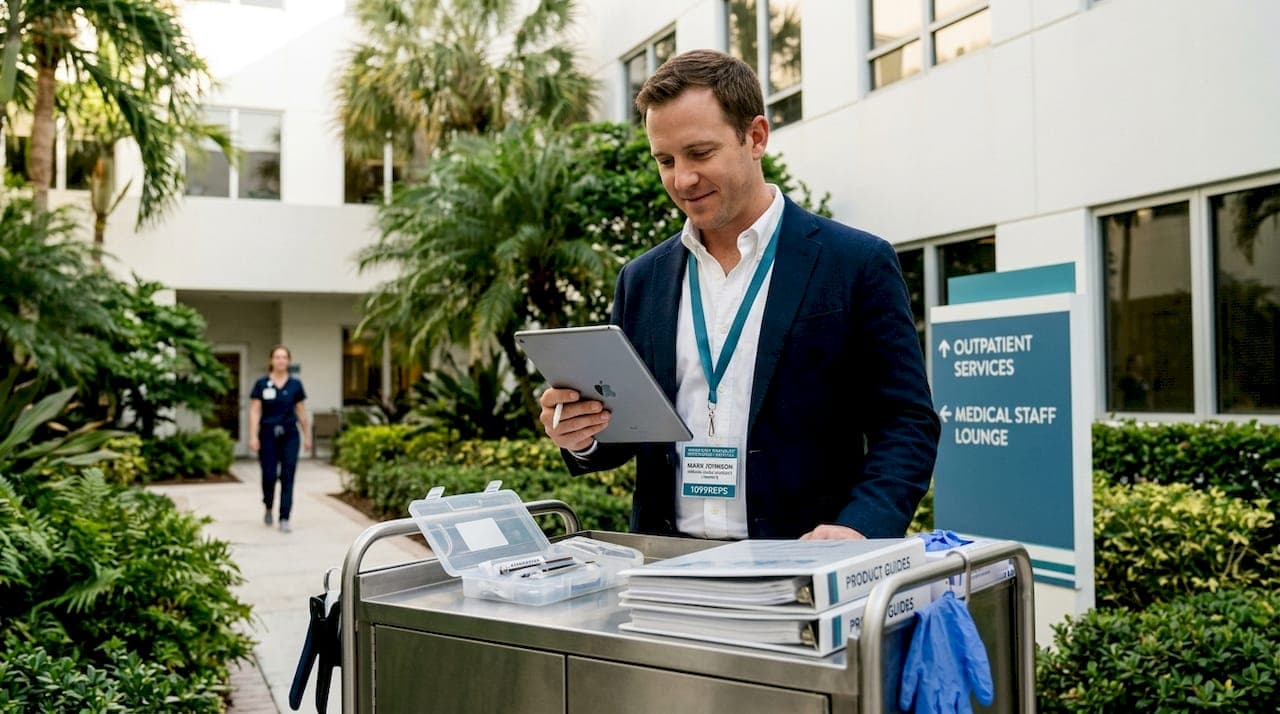
Breaking into medical sales is competitive, and the associate sales rep position is where most careers begin. Yet this role is widely misunderstood. Many candidates assume it is simply a junior version of a territory manager job, with lighter responsibilities and a slow learning curve. The reality is almost the opposite. Understanding what is an associate sales rep position, what it demands day to day, and where it can take your career is the clearest advantage you can give yourself before applying.
Table of Contents
- Key takeaways
- What an associate sales rep actually does
- Qualifications and requirements for the role
- How the role differs across companies and sectors
- Career progression after the associate role
- My honest take on the associate role
- Start your medical sales career with the right platform
- FAQ
Key takeaways
| Point | Details |
|---|---|
| Role is field-intensive | Associates support surgical cases, manage samples, and build clinician relationships on the ground. |
| Qualifications go beyond a degree | Credentialing, CRM proficiency, and travel flexibility matter as much as your educational background. |
| Title varies widely | "Associate sales rep" can mean inside sales or OR-based field support depending on the company. |
| Success is measured differently | Performance is tracked by case coverage and CRM accuracy, not immediate sales numbers. |
| Promotion follows a structured path | Most associates advance to Territory Manager through mentorship programs and measurable benchmarks. |
What an associate sales rep actually does
The associate sales rep role in medical device companies like Baxter, Stryker, and Arthrex is built around supporting senior reps in the field, covering surgical cases, and building trust with clinical staff. It is not a desk job. On any given day, you might be in an operating room before 6 a.m. helping a surgeon use an orthopedic implant system, then updating a CRM record by noon, then delivering product samples to a hospital account in the afternoon.
Here is a breakdown of the core associate sales representative duties you will encounter:
- Surgical case coverage: Attending procedures to provide real-time product and technical support to surgeons and OR staff. This is the most critical and visible part of the role.
- Relationship building: Developing working relationships with clinicians, nurses, surgical techs, and hospital purchasing staff across your assigned territory.
- CRM maintenance: Inputting customer data and opportunity information accurately into systems like Salesforce to support pipeline development and forecasting.
- Product promotion and training support: Assisting senior reps with product demonstrations, in-service training sessions, and new product introductions to clinical teams.
- Sample and inventory management: Tracking loaner kits, consignment trays, and sample inventory to make sure the right products are available for scheduled cases.
- On-call and travel duties: Being available evenings and weekends to support unplanned or emergency surgical cases within your territory.
One thing that surprises most new associates is how much of the role is logistical. You are the person who makes sure the right implant tray arrives at the right hospital at the right time. Senior reps depend on associates to handle onsite support so they can focus on strategic account development. That dependency means your reliability directly affects the team's revenue, even before you are selling independently.
Pro Tip: Treat your CRM entries as seriously as your OR coverage. Managers evaluate associates on data accuracy and completeness, and clean records are often what separates candidates who get promoted from those who plateau.
Qualifications and requirements for the role
Most medical device companies list a bachelor's degree as preferred, though not always required. What matters more in practice is a combination of relevant experience, technical aptitude, and the willingness to meet demanding logistical and compliance standards.
Here is what employers typically look for when hiring for entry-level sales jobs in the medical device space:
- Education: A bachelor's degree in life sciences, business, kinesiology, or a related field is the most common baseline. Some companies will accept equivalent clinical experience in place of a degree.
- Experience: Postings from Baxter and Stryker typically ask for one to four years of experience in healthcare, B2B sales, or a clinical setting such as surgical technology or physical therapy.
- CRM and tech proficiency: Familiarity with Salesforce or similar platforms is a real differentiator. Companies want associates who can manage data without hand-holding.
- Travel readiness: Travel requirements often reach 50% or more, including overnight trips two to four times per month and regular early morning or weekend availability.
- Credentialing and compliance: Before you can set foot in most hospital operating rooms, you must complete a credentialing process that includes vaccination verification, background checks, and facility-specific clearances. This process can take weeks and affects your onboarding timeline significantly.
The credentialing requirement catches many candidates off guard. You may accept an offer and still be unable to cover your first case for four to six weeks while clearances are processed. Planning for that gap is part of how to become a sales rep who starts strong rather than scrambling.
How the role differs across companies and sectors
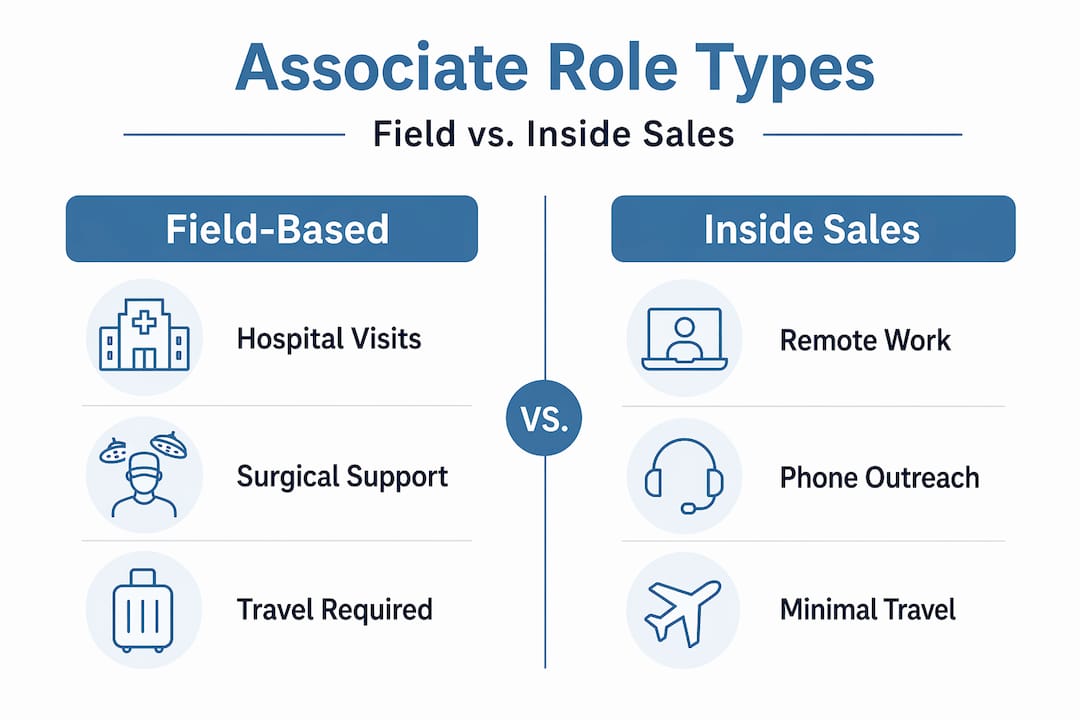
Here is where a lot of job seekers get confused. The title "associate sales representative" does not mean the same thing everywhere. Job title alone is insufficient to define what you will actually be doing. The associate sales role description varies significantly based on the company type, product category, and sales model.
The table below summarizes the key differences you will encounter:
| Factor | Field/OR-based associate | Inside sales associate |
|---|---|---|
| Primary setting | Hospital, OR, clinical accounts | Office or remote, phone and digital channels |
| Core activity | Case coverage, product support | Lead generation, outbound outreach |
| Travel requirement | High (50%+, including weekends) | Low to moderate |
| Credentialing required | Yes, often mandatory | Rarely required |
| Success measured by | Case coverage, CRM accuracy, relationships | Call volume, pipeline creation, conversion rates |
| Typical industries | Medical devices, surgical products | Technology, SaaS, general B2B |
If you are targeting medical sales specifically, you are almost certainly looking at the field-based model. That means OR presence, early mornings, and a territory you own logistically before you own it commercially. Reading job descriptions closely is not optional. Look for phrases like "case coverage," "OR support," "consignment management," and "clinical in-service" to confirm you are applying for a field role rather than an inside sales position.
Pro Tip: When evaluating a posting, search the job description for the word "travel" and note the percentage. Anything above 40% with on-call language signals a true field associate role in medical devices.
Career progression after the associate role
The associate position is a structured apprenticeship, not a permanent station. Most companies design it with a clear endpoint: promotion to Territory Manager or senior sales representative. Understanding the career path for sales reps in medical devices helps you set realistic timelines and focus your energy on the right activities.
Here is how progression typically unfolds:
- Months one through six: You are in learning mode. Shadowing senior reps, completing product training, finishing credentialing, and covering cases under supervision. Your goal is clinical competency and relationship building, not closing deals.
- Months six through twelve: You begin taking on accounts independently within your territory. Performance is measured by case coverage, CRM data quality, and your ability to support the senior rep's pipeline without being prompted.
- Year one to two: Formal mentorship deepens. Stryker and Arthrex both describe development programs where associates receive structured coaching and are evaluated against promotion benchmarks. Compensation during this phase typically includes a base salary plus incentive pay tied to territory performance.
- Year two and beyond: Associates who consistently hit execution benchmarks and demonstrate independent clinical competency are promoted to Territory Manager. At that point, you own a full quota and manage your own accounts without a senior rep above you.
The 1099 medical sales rep landscape also offers an alternative path for experienced associates who prefer independent contractor arrangements, which can accelerate earnings and territory ownership on a different timeline.
What separates associates who advance quickly from those who stall is rarely clinical knowledge. It is consistency. Managers notice who shows up early, who keeps their CRM clean without being reminded, and who builds genuine relationships with OR staff rather than just completing tasks. Those behaviors signal readiness for a territory of your own.

My honest take on the associate role
I have watched a lot of people enter medical sales with the wrong expectations, and the associate position is where that gap shows up fastest. Most candidates focus on the career upside, the earnings potential, the prestige of selling surgical products, and they underestimate how demanding the foundation work actually is.
In my experience, the associates who thrive are not necessarily the most polished salespeople. They are the ones who genuinely enjoy being in the OR, who take the time to learn the anatomy behind the products they support, and who treat every interaction with a scrub tech or OR coordinator as a relationship worth investing in. That reputation compounds over time. Treat your professional reputation as currency, because in a hospital system, everyone talks.
The common pitfall I see is impatience. Associates want to start selling before they have earned the trust of the clinical staff they serve. Rushing that process damages credibility in ways that are hard to recover from. The learning phase is not a delay. It is the actual work.
What I find most underappreciated about this role is its leverage. A great associate does not just support one senior rep. They expand what that senior rep can accomplish by handling the operational complexity that would otherwise slow everything down. That contribution is real, even when it is not measured in closed deals.
— Joshua
Start your medical sales career with the right platform
If you are ready to move from researching the associate sales rep position to actually pursuing it, where you search matters. Generic job boards surface roles that may not align with your clinical background, territory preferences, or product experience. That mismatch costs you time.

1099reps connects medical sales professionals with manufacturers who are actively seeking reps with specific clinical specialties and territory coverage. The platform uses AI matching to align your background with the right opportunities, so you are not sorting through irrelevant listings. Whether you are looking for your first associate role in medical sales or ready to explore independent contractor arrangements as your career grows, the 1099reps platform gives you a focused, efficient starting point. Visit 1099reps.com to explore current openings and build a profile that gets noticed by the right manufacturers.
FAQ
What does an associate sales rep do in medical sales?
An associate sales rep supports senior reps by covering surgical cases, managing sample inventory, maintaining CRM records, and building relationships with clinicians and hospital staff. The role is field-based and operationally intensive, particularly in medical device companies.
What qualifications do you need for an associate sales rep job?
Most employers prefer a bachelor's degree plus one to four years of experience in healthcare or B2B sales. Travel flexibility, CRM proficiency, and the ability to complete hospital credentialing requirements are equally important in practice.
How long does it take to get promoted from associate to Territory Manager?
Most associates are promoted within one to two years, depending on performance benchmarks set by the company. Stryker and Arthrex both use structured development programs with defined milestones that guide the promotion timeline.
Is an associate sales rep position the same as inside sales?
No. In medical devices, associate sales reps are typically field-based and work directly in hospital and surgical settings. Inside sales associate roles at other companies focus on outbound outreach and lead generation with little to no travel or OR presence.
Do associate sales reps need to be credentialed before working in hospitals?
Yes. Most hospital environments require credentialing before any sales rep can enter clinical or surgical areas. This process includes background checks, vaccination verification, and facility-specific clearances, and it can delay your start date by several weeks.