

Picking the right specialty is one of the most consequential decisions you will make in your medical sales career path. Most people entering the field know they want to sell medical products, but they underestimate how much the specialty they choose shapes their daily life, income ceiling, and long-term career trajectory. When you choose medical sales specialty focus areas without a clear framework, you risk landing in a role that drains your energy and limits your earning potential. This guide gives you a practical, honest process for matching your background, goals, and market reality to the right specialty before you commit.
Table of Contents
- Key takeaways
- How to choose your medical sales specialty focus
- How job realities differ across specialties
- Market demand and compensation by specialty
- Entry requirements by specialty
- Your action plan for choosing a specialty
- My honest take on choosing a specialty
- Find your specialty fit with 1099reps
- FAQ
Key takeaways
| Point | Details |
|---|---|
| Background alignment matters most | Matching your clinical or sales experience to a specialty increases performance and shortens your ramp-up time. |
| Job realities vary dramatically | Daily workflows differ widely across specialties, from OR case coverage to office-based pharma detailing. |
| Compensation differs by specialty | Surgical robotics and spine sales lead total compensation, while supplies and pharma offer more predictable base pay. |
| Market demand is shifting | Ambulatory surgery centers are expanding, creating strong growth in orthopedics, sports medicine, and biologics. |
| Employment model affects specialty fit | W-2 and 1099 structures align differently with specialty sales cycles, risk tolerance, and territory control. |
How to choose your medical sales specialty focus
The foundation of a smart specialty decision is self-assessment. Medical sales reps most often specialize in pharmaceuticals, medical devices, health care management services, or medical supplies, and your background is the single best predictor of where you will thrive.
Here is how common backgrounds map to specialties:
- Healthcare or clinical background (nurses, surgical techs, physical therapists): Medical devices, orthopedics, spine, or biologics. Your clinical vocabulary and OR familiarity are assets most reps spend years building.
- IT or software background: Health technology and digital health solutions. You already understand system integrations, workflows, and the language of hospital administrators.
- Prior B2B sales experience: Medical supplies or health care management services. The sales motion is familiar, and the learning curve focuses on product knowledge rather than sales fundamentals.
- Science or pharma degree: Pharmaceutical or biotech specialty roles. Your ability to communicate clinical data fluently is exactly what brand teams need.
Personal motivation matters just as much as background. Reps who choose a specialty purely for the paycheck often burn out when the role demands more than they expected. Ask yourself honestly whether you want to be in the OR at 6 a.m., or whether you prefer a structured office schedule with predictable call patterns. Neither answer is wrong. They just point to different specialties.
Pro Tip: Before you commit to a specialty, spend time reading the actual job postings in your target market. Look at what qualifications companies are asking for and whether your background genuinely checks those boxes. This takes 30 minutes and saves months of misdirected effort.
Strong relationship-building skills also factor into specialty fit. Some specialties, like orthopedics or spine, require you to build deep trust with surgeons over years. Others, like pharma detailing, involve broader but shallower contact networks. Know which dynamic energizes you.
How job realities differ across specialties
Understanding what your day actually looks like in each specialty is where most people do their weakest research. Reading a job description is not the same as knowing the role.
Here are the key dimensions where specialties diverge:
-
Case coverage intensity. Device specialties like orthopedic reconstruction require you to be physically present in the OR for procedures. Orthopedic joint replacement cases run one to two hours, and you may cover multiple cases per day. This means early mornings, unpredictable schedules, and deep clinical involvement.
-
Product technicality. Surgical robotics and spine devices demand a high level of technical knowledge. You need to understand anatomy, surgical technique, and implant mechanics. Pharma and supplies roles are technically lighter, with more emphasis on messaging and relationship management.
-
Sales environment. Orthopedic and spine reps spend their time in hospitals and surgery centers. Pharma reps spend most of their time in physician offices and clinics. Health tech reps often work with hospital administrators and IT departments in conference rooms.
-
Sales cycle length. Surgical robotics can involve 12 to 18 month capital sales cycles. Pharma detailing involves shorter, repetitive contact cycles. Supplies and commodity products can move quickly but face more price competition.
-
Lifestyle implications. High-acuity device roles often come with on-call responsibilities and weekend coverage. Pharma and health tech roles tend to offer more schedule predictability. This is not a minor consideration if you have family commitments or geographic constraints.
-
Client interaction depth. In biologics and spine, you often become a clinical resource the surgeon relies on. In supplies, your primary contacts may be purchasing managers and materials directors rather than clinicians.
Pro Tip: Talk directly to OR staff, scrub techs, and circulators in your local hospitals. OR staff can reveal which product categories are underserved and where reps are not showing up consistently. This street-level intelligence tells you more about local opportunity than any industry report.
Market demand and compensation by specialty
Knowing where the money is and where the market is growing are two different questions. You need both answers.
Ambulatory surgery centers are expanding the range of procedures they perform, which is creating strong tailwinds for orthopedics, spine, sports medicine, and biologics. Reps in these growth segments benefit from rising procedure volumes and new product adoption cycles. Commodity supply reps, by contrast, face margin compression and procurement consolidation.
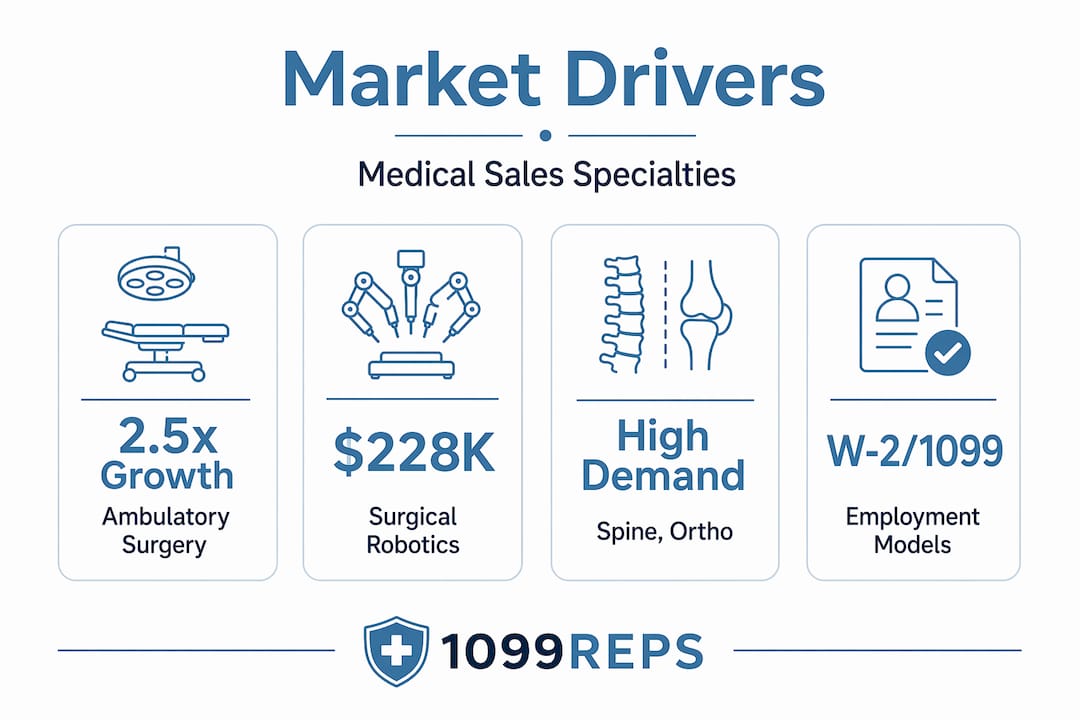
Here is a compensation comparison by specialty based on 2026 salary data:
| Specialty | Base Salary Range | Total Compensation Range | Market Growth |
|---|---|---|---|
| Surgical robotics | $82K–$95K | $161K–$228K | High |
| Spine devices | $68K–$82K | $134K–$197K | High |
| Orthopedic reconstruction | $68K–$78K | $118K–$171K | Moderate to high |
| Cardiovascular devices | $70K–$85K | $115K–$165K | Moderate |
| Sports medicine | $60K–$75K | $95K–$140K | Growing |
| Biologics/pharma specialty | $65K–$80K | $100K–$145K | High |
| Medical supplies | $50K–$65K | $70K–$100K | Stable |
A few things stand out in this data. Surgical robotics offers the highest ceiling, but the sales cycle is long and the technical bar is high. Spine pays well and has strong market momentum, but OR coverage demands are intense. Sports medicine and biologics offer a middle path with growing demand and more manageable lifestyle implications.
Territory and surgeon volume also shape your actual earnings significantly. A spine rep covering a high-volume trauma center will outperform a spine rep in a low-volume rural market, even with the same product line. Finding territories with surgeon unmet needs rather than competing head-to-head in saturated accounts is how smart reps build income faster.
The employment model you choose also matters here. W-2 roles offer a salary floor and structured territories, which suits longer sales cycles like capital equipment and robotics. A 1099 independent rep model offers uncapped earnings and territory control, which works better for specialties with shorter sales cycles and repeat purchasing patterns. Understanding how commission structures work in your target specialty before you sign any agreement is non-negotiable.

Entry requirements by specialty
Knowing what companies actually require helps you assess your readiness honestly and identify any gaps you need to close.
- Pharmaceuticals and biotech specialty roles typically require a Bachelor's degree plus three or more years of sales or clinical experience. Some pharma roles accept an Associate's degree with six years of experience, or a GED with eight years of demonstrated results. The bar is flexible, but clinical knowledge and sales track record are both weighted heavily.
- Medical device roles in orthopedics, spine, and surgical robotics strongly favor candidates with clinical backgrounds or prior device sales experience. Companies want reps who can walk into an OR and speak the language immediately.
- Health technology roles often prioritize B2B software or SaaS sales backgrounds alongside healthcare familiarity. A track record of selling to hospital administrators or clinical decision-makers is a significant advantage.
- Medical supplies and distribution have the most accessible entry requirements. Prior sales experience in any field, combined with product knowledge and territory management skills, is often sufficient to get started.
- Biotech specialty roles require the ability to deliver branded sales messages, manage reimbursement conversations, and conduct educational programs for clinical staff. These roles reward reps who can blend clinical depth with commercial execution.
If you are transitioning from a clinical role, your credential is your advantage. Lead with it. If you are coming from outside healthcare entirely, focus on building product knowledge through certifications, informational interviews, and any part-time clinical exposure you can arrange.
Your action plan for choosing a specialty
A clear process removes the paralysis that comes from too many options. Work through these steps in order.
- Evaluate your background and interests. Write down your education, your most relevant work experience, and the three work environments where you have performed best. Match these against the specialty categories above.
- Research daily work demands. Shadow a rep in your target specialty if possible, or conduct informational interviews with two or three people currently working in that role. Ask about their typical week, not their best week.
- Assess market demand in your geography. Look at hospital density, surgery center growth, and surgeon volume in your target territory. A specialty with national growth may be saturated or underdeveloped in your specific market.
- Review qualification requirements honestly. Pull five to ten job postings in your target specialty and compare the requirements to your current profile. Note the gaps and estimate how long it would take to close them.
- Identify viable territory opportunities. Talk to OR staff, attend local medical association events, and connect with reps already working the area. The 1099 medical sales landscape in your region may reveal open territory that a national job board would never surface.
- Build a prioritized shortlist and test it. Narrow your options to two or three specialties. Start networking conversations with hiring managers, distributors, and independent reps in each. The conversations themselves will tell you which specialty feels right and where you have the most traction.
Pro Tip: The most common mistake people make when selecting a medical sales niche is choosing based on compensation data alone without validating local market demand. A specialty that pays well nationally can be a dead end in your specific territory if the surgical volume is not there.
My honest take on choosing a specialty
I have watched a lot of talented people struggle in medical sales not because they lacked skill, but because they picked the wrong specialty for the wrong reasons. The chase for the highest total comp number is the most common trap. Surgical robotics looks incredible on paper. But if you are not genuinely comfortable in a hospital environment, cannot handle a 14-month sales cycle with no commission, and do not have the clinical credibility to earn a surgeon's trust, that comp ceiling is theoretical.
What I have found actually works is starting with the environment you want to work in, then working backward to the specialty that fits it. If you love clinical settings and fast-paced days, device sales in orthopedics or sports medicine will energize you. If you prefer a structured schedule and data-driven conversations, pharma or health tech may be a better fit. Neither path is inferior. The one that aligns with your strengths and lifestyle is the one where you will outperform.
I also want to be direct about market dynamics. Demand shifts. A specialty that is growing today may face pricing pressure or consolidation in three years. The reps who sustain long careers are the ones who stay curious, keep learning, and treat their clinical knowledge as something to build continuously, not a credential to coast on. Flexibility and local market intelligence are more durable advantages than any single specialty label.
— Joshua
Find your specialty fit with 1099reps
If you are ready to move from research to action, 1099reps is built for exactly this moment in your career. The platform connects independent medical sales reps with manufacturers looking for specialized expertise, using AI matching to align your clinical background and territory with the right product lines.
Whether you are exploring medical sales opportunities for the first time or looking to shift into a new specialty, 1099reps gives you access to a curated job board with roles organized by specialty and region. You can also browse available product lines to get a concrete sense of where your background fits best. The platform removes the guesswork and connects you with manufacturers who are actively looking for reps with your profile.
FAQ
What is the best medical sales specialty for beginners?
Medical supplies and pharmaceutical sales typically have the most accessible entry requirements and offer structured training programs. They are strong starting points for building foundational sales skills before moving into higher-acuity device roles.
How much do medical sales reps earn by specialty?
Compensation varies significantly. Surgical robotics reps earn $161K to $228K in total compensation, while spine reps earn $134K to $197K. Medical supplies roles typically range from $70K to $100K in total comp.
Do I need a clinical background to get into medical device sales?
A clinical background is a strong advantage, particularly for OR-based specialties like orthopedics and spine, but it is not always required. Companies also hire reps with strong B2B sales records who demonstrate the ability to learn clinical content quickly.
How do I select a medical sales niche that fits my territory?
Talk to OR staff, scrub techs, and local surgeons to identify underserved product categories in your area. National market trends matter, but local surgical volume and unmet needs in your specific geography are what actually determine your income potential.
What is the difference between W-2 and 1099 in medical sales?
W-2 roles provide a base salary and structured territory, which suits long capital equipment sales cycles. A 1099 independent rep model offers higher earning potential and territory control, and works best in specialties with shorter, repeat-purchase sales cycles.